Getting Started with Watch Repair
Working on mechanical watches is part engineering, part art. These tiny machines contain hundreds of precisely machined parts working in harmony. Learning to service them yourself is deeply satisfying and can save significant money on routine maintenance.
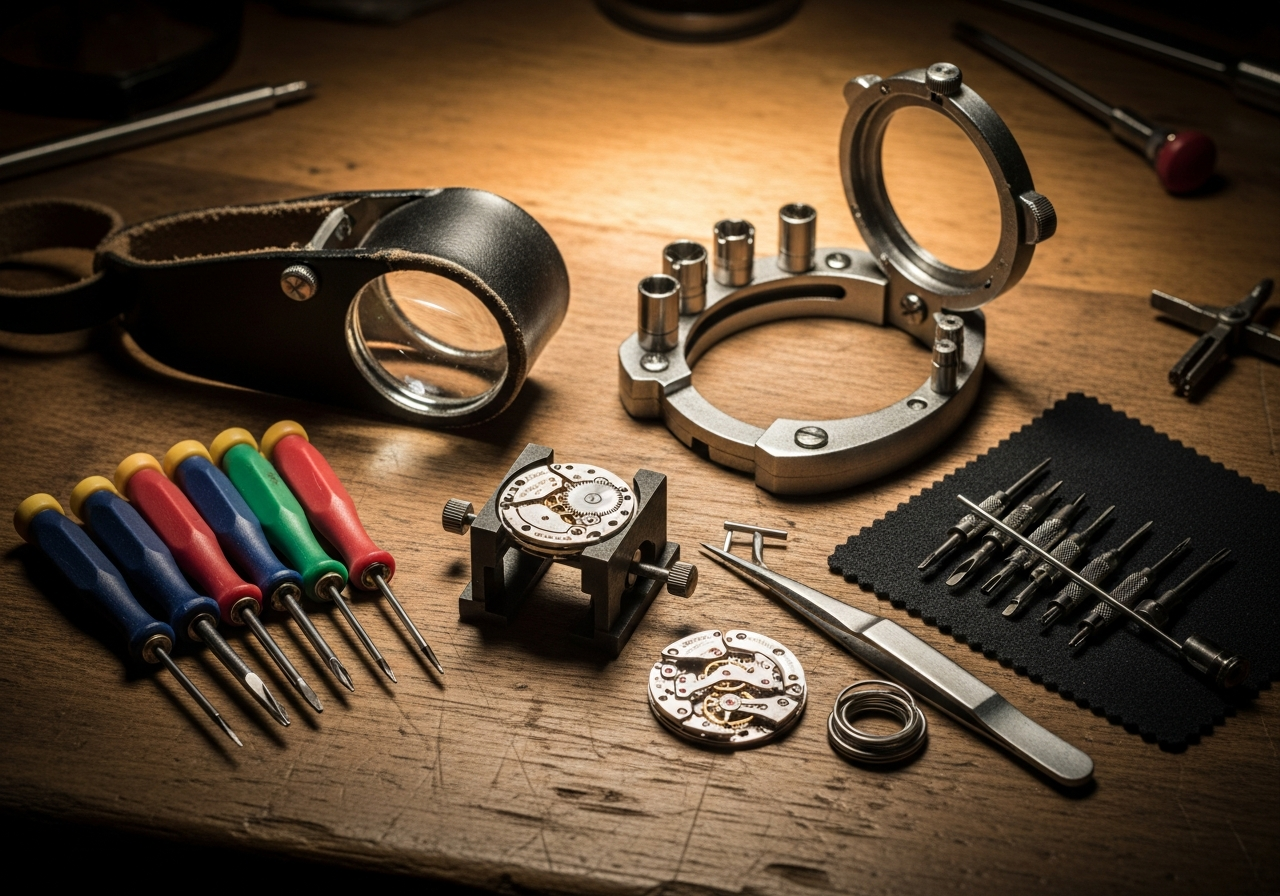
Essential Watch Repair Tools
- **Loupe (magnifier)** — A 10x or 20x eye loupe is essential for seeing tiny components
- **Case opener** — A friction-ball or adjustable opener for screw-back and snap-back cases
- **Precision screwdrivers** — Micro screwdrivers for movement screws
- **Spring bar tool** — For removing and installing watch bands
- **Tweezers** — Anti-magnetic tweezers for handling delicate parts
- **Movement holder** — Secures the movement while you work
Types of Watch Repair
Start with these beginner-friendly tasks: 1. **Battery replacement** — The simplest and most common watch repair 2. **Band/strap changes** — Using a spring bar tool to swap bands 3. **Crystal replacement** — Replacing scratched watch glass 4. **Case cleaning** — Polishing and cleaning the exterior 5. **Basic movement service** — Cleaning and oiling (advanced)
Tips for Beginners
- Work on a clean, white surface — dropped screws are nearly invisible on dark surfaces
- Use a **parts tray** with sections to organize removed components in order
- Take photos at each step so you can reverse the disassembly
- Start with inexpensive watches before working on anything valuable
- Keep your workspace dust-free — dust is the enemy of watch movements
- Never force anything — if it won't move, you're doing something wrong
Common Mistakes to Avoid
- Using magnetic tools near movements — magnetism ruins watch accuracy
- Touching movement parts with bare fingers — oils cause corrosion
- Over-tightening case backs — it cracks crystals and damages gaskets
- Attempting complex repairs without proper training — know your limits