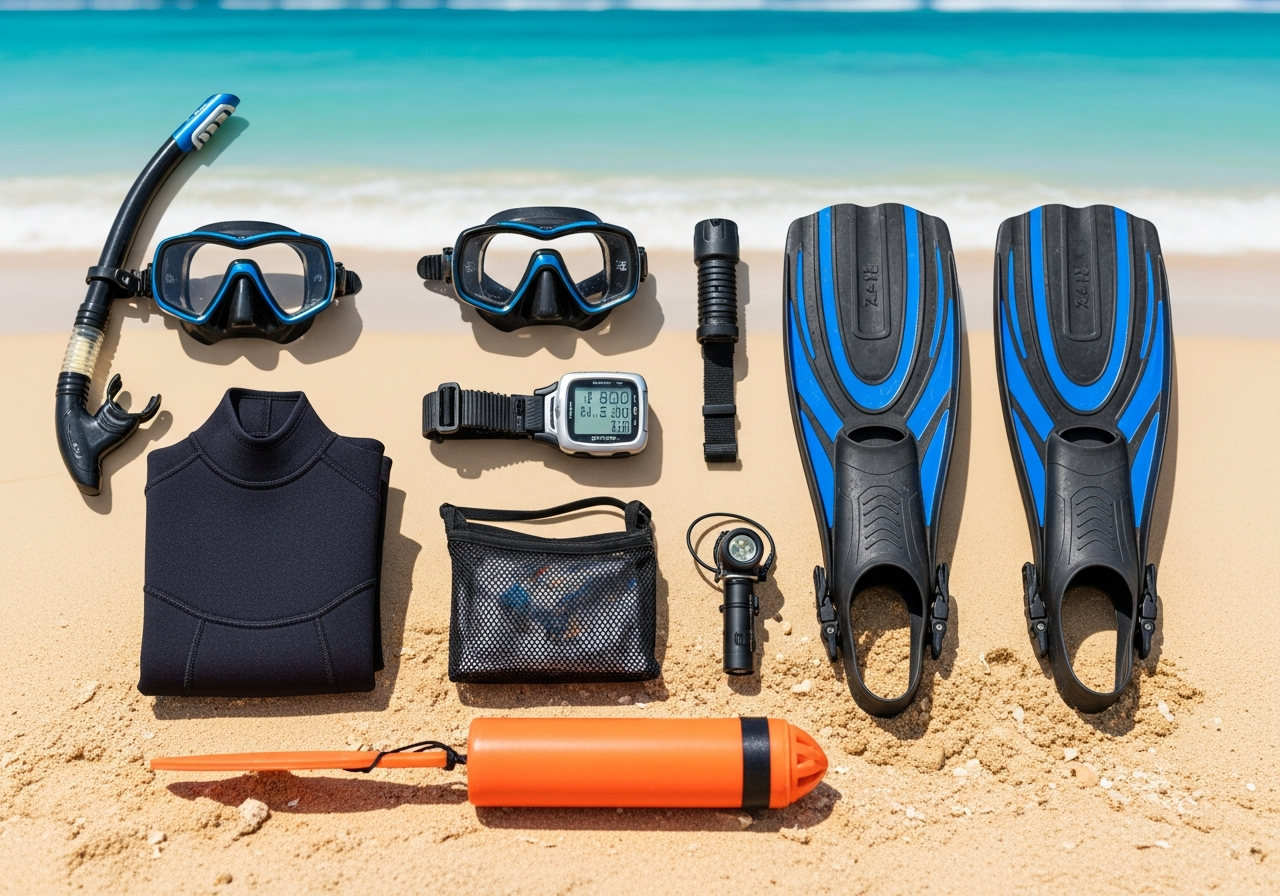
Scuba Diving Essentials Checklist — Your Complete Guide
Personal dive gear essentials for new open water certified divers. Your complete essentials checklist — find out exactly what you need to buy and what can wait.
Scuba diving opens up an incredible underwater world of coral reefs, marine life, and shipwrecks. While you'll rent tanks and BCDs from dive shops, owning your own personal gear — mask, fins, snorkel, wetsuit, and dive computer — ensures a better fit, more comfort, and a safer diving experience. This kit covers what every newly certified diver should own.
Here is everything included in this bundle at a glance:
Dive Mask ($30 - $70) — Essential
Dive Fins ($40 - $90) — Essential
Dive Computer ($100 - $250) — Essential
Wetsuit ($50 - $120) — Essential
Snorkel ($15 - $35) — Essential
Dive Boots ($20 - $45)
Mesh Gear Bag ($15 - $30)
Dive Log Book ($8 - $18)
Must-Have Items (5)
These are the core items required to get started. Do not skip these.
Dive Mask — $30 - $70 Low-volume silicone mask with tempered glass lenses for clear underwater vision.
Dive Fins — $40 - $90 Open-heel or full-foot fins for efficient propulsion underwater.
Dive Computer — $100 - $250 Wrist-mounted dive computer tracking depth, time, and no-deco limits.
Wetsuit — $50 - $120 3mm neoprene wetsuit for thermal protection in tropical and temperate waters.
Snorkel — $15 - $35 Dry-top snorkel for surface swimming and pre-dive breathing.
Nice to Have (3)
These optional items improve convenience, presentation, or overall experience.
Dive Boots — $20 - $45 Neoprene boots for warmth and protection when using open-heel fins.
Mesh Gear Bag — $15 - $30 Large mesh bag for drying and transporting wet dive gear.
Dive Log Book — $8 - $18 Waterproof log book for recording dive details and marine life sightings.
Getting Started with Scuba Diving
Scuba diving is one of those hobbies that changes how you see the world — literally. Once you've floated weightlessly over a coral reef or explored a sunken wreck, you'll be hooked. The first step is getting Open Water certified through PADI or SSI, which takes 3-4 days. After that, owning your own personal gear makes every dive more comfortable and enjoyable.
Essential Personal Dive Gear
Your **dive mask** is the most personal piece of equipment — it needs to seal perfectly to your face. Quality **fins** with the right stiffness and fit improve your efficiency and reduce fatigue. A **dive computer** tracks your depth, time, and decompression limits — it's the most important safety tool after your training. And a **wetsuit** keeps you warm and protected from stings and scrapes.
Tips for Newly Certified Divers
Dive frequently after certification — skills fade fast if you don't practice
**Always do a buddy check** — test your gear and your partner's before every dive
Log every dive — it tracks your experience and helps with advanced certifications
Start with easy, shallow dives and build up to deeper, more challenging sites
Equalize your ears early and often during descent
Common Mistakes to Avoid
Ascending too quickly — always follow your computer's ascent rate
Skipping the pre-dive safety check — it takes 60 seconds and saves lives
Buying a mask online without trying it on — fit is everything
Holding your breath — the #1 rule of scuba is never hold your breath
Touching marine life — it damages ecosystems and can injure you
Related Starter Kits
Kayaking Starter Kit — Essential safety and comfort gear for your first time on the water.
Can I buy individual items instead of the full bundle?
Yes! Each item links directly to Amazon where you can purchase individually. Start with the must-have items and add nice-to-haves over time.
How are products selected for this bundle?
We research customer reviews, expert opinions, and real-world performance data to select the best products at various price points for each item category.
As an Amazon Associate, BundleMatchly earns from qualifying purchases. Prices are approximate and may change.